Dhanurdhara’s Post 2007 Initiations Are Not Recognized in ISKCON by GBC and CPO
In 2007 the GBC RESOLVED:
“Whenever the ISKCON Central Office of Child Protection rules that an offense is such as to restrict a person from serving in ISKCON in positions of leadership (including but not limited to offices of GBC, minister, zonal secretary or temple officer), the restriction must include the position of initiating guru. This restriction shall apply to all previous and future decisions of the Central Office of Child Protection.
A devotee initiated by a guru subsequently affected by this resolution is considered to have been duly initiated under the authority of ISKCON and the GBC and is recognized as an ISKCON member in good standing with all the privileges of an initiate. Other questions that may arise in the application of this law should be referred to the Executive Committee of the GBC.”
In 2007 the ISKCON CPO CLARIFIED:
“We can categorically state that Dhanurdhara Maharaja, and any others with similar CPO decisions, may not act as initiating spiritual masters in ISKCON.”
In 2020 the ISKCON North American GBC CONFIRMED:
“So the conclusion is that the North American GBC Council are not willing to make any changes in Dhanurdhara Swami’s status and he will remain outside of ISKCON in North America.”
In 2020 the ISKCON CPO CONFIRMED:
“Dhanurdhara Swami remains outside of ISKCON North America. His choice to live as a sannyasi and a guru is his own independent choice.”
ISKCON’s GBC and CPO Don’t Recognize Dhanurdhara as a Sannyasi or Guru
In 2006 ISKCON’s Child Protection Office (CPO) and Legal Council SUMMARIZED:
“As a result of the litigation in Texas, and the 600-plus claims filed in the bankruptcy court, we now have a vast body of information (evidence) that was not available in 1999. Although much was known with respect to allegations of physical and mental child abuse by Dhanurdhara Swami at the Vrindavan gurukula, we have now have even more information than we had at that time. Based upon this additional information, it is now unequivocally clear to ISKCON’s legal team that the damage inflicted by Dhanurdhara Swami was significantly greater than that which was known in 1999. In fact, Dhanurdhara Swami is named as an abuser in the bankruptcy claims far more than any other person.”
“We have seen and reviewed first hand the claims filed in the bankruptcy court documenting the severe abuse inflicted on the Vrindavana gurukula children by Dhanurdhara Swami, as well as the CPO information. From a legal standpoint, we have no doubt that these claims are legitimate.”
In 2007 the GBC RESOLVED:
“Whenever the ISKCON Central Office of Child Protection rules that an offense is such as to restrict a person from serving in ISKCON in positions of leadership (including but not limited to offices of GBC, minister, zonal secretary or temple officer), the restriction must include the position of initiating guru. This restriction shall apply to all previous and future decisions of the Central Office of Child Protection.”
In 2007 the ISKCON CPO CLARIFIED:
“We can categorically state that Dhanurdhara Maharaja, and any others with similar CPO decisions, may not act as initiating spiritual masters in ISKCON.”
In 2011 the GBC RESOLVED:
“The GBC is responsible to see that Srila Prabhupada’s teachings are properly represented and that the standards expected of sannyasis, initiating gurus and other spiritual leaders are upheld. The GBC holds those who represent Srila Prabhupada as sannyasis and diksa gurus to the highest standards of moral and ethical behavior.”
In 2018 the GBC RESOLVED:
“No person, who has been determined to have engaged in severe maltreatment of children, will be allowed to remain active in a position of authority or trust within ISKCON, this includes activities such as leading kirtan, giving class, speaking publicly at any ISKCON event or representing ISKCON in official capacities.”
In 2020 the ISKCON North American GBC Confirmed:
“So the conclusion is that the North American GBC Council are not willing to make any changes in Dhanurdhara Swami’s status and he will remain outside of ISKCON in North America.”
In 2020 the ISKCON CPO Confirmed:
“Dhanurdhara Swami remains outside of ISKCON North America. His choice to live as a sannyasi and a guru is his own independent choice.”
Additional Verification:
With a quick look at the ISKCON Sannyasa Ministry List of Sannyasis, as well as the ISKCON GBC List of Initiating Gurus, it is easy to see Dhanurdhara is not named on either.
Dhanurdhara’s Sannyasa is not Recognized by ISKCON’s Sannyasa Ministry
With a quick look at the ISKCON Sannyasa Ministry List of Sannyasis it is easy to see Dhanurdhara is not on it.
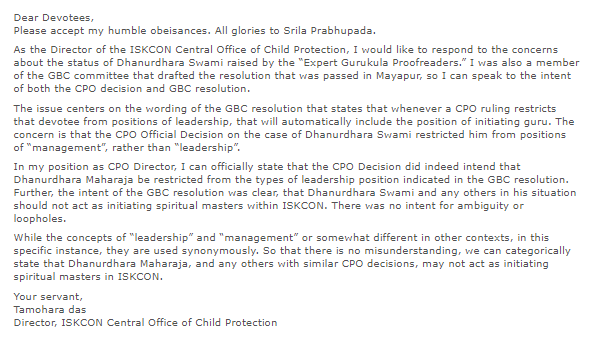
2007 ISKCON CPO Clarification of Status for Dhanurdhara
2007 ISKCON Child Protection Office Clarification of Status for Dhanurdhara Swami
Originally posted by Tamohara Das on Dandavats, April 25th, 2007.
“Dear Devotees,
Please accept my humble obeisances. All glories to Srila Prabhupada.
As the Director of the ISKCON Central Office of Child Protection, I would like to respond to the concerns about the status of Dhanurdhara Swami raised by the “Expert Gurukula Proofreaders.” I was also a member of the GBC committee that drafted the resolution that was passed in Mayapur, so I can speak to the intent of both the CPO decision and GBC resolution.
The issue centers on the wording of the GBC resolution that states that whenever a CPO ruling restricts that devotee from positions of leadership, that will automatically include the position of initiating guru. The concern is that the CPO Official Decision on the case of Dhanurdhara Swami restricted him from positions of “management,” rather than “leadership.”
In my position as CPO Director, I can officially state that the CPO Decision did indeed intend that Dhanurdhara Maharaja be restricted from the types of leadership positions indicated in the GBC resolution. Further, the intent of the GBC resolution was clear, that Dhanurdhara Swami, and any others in his situation, should not act as initiating spiritual masters within ISKCON. There was no intent for ambiguity or loopholes.
While the concepts of “leadership” and “management” are somewhat different in other contexts, in this specific instance, they are used synonymously. So that there is no misunderstanding, we can categorically state that Dhanurdhara Maharaja, and any others with similar CPO decisions, may not act as initiating spiritual masters in ISKCON.
Your servant,
Tamohara das
Director, ISKCON Central Office of Child Protection“
Dhanurdhara’s 2006 ISKCON CPO Summary Report to GBC
2006 Summary and Notes to the CPO Case of Dhanurdhara Swami
Many devotees, including some of our leaders, are only vaguely familiar with the exact nature of the 1999 ISKCON Child Protection Office (CPO) decision against Dhanurdhara Swami. Some devotees have expressed that his offenses were minor, he was a scapegoat for other’s abuse, or the evidence was weak. I would like to correct some of these misconceptions.
The attached Child Protection Office Official Decision provides an excellent overview of the history, evidence, and conclusions of this case. However, it does not present all the testimony and evidence, but only a sampling. In this introduction, I wish to give a fuller understanding of the case and evidence that the judges evaluated.
The conclusions of the judges were unanimous, finding Dhanurdhara Swami personally responsible for child neglect, child physical abuse, and child psychological abuse. They also found him responsible for failure to adequately supervise the teaching staff and thus he failed to protect the children from even more severe abuse.
This managerial failure is summarized by Sri Rama Prabhu, at that time Minister of Education, whose comment is in the case file, but not quoted in this decision. He stated, “To the best of my knowledge, Dhanurdhara Swami did not sexually abuse the students. But he let a lot go on, with his knowledge. The evidence from former gurukula students is overwhelming – both of neglect and willful non-sexual personal abuse. He was warned numerous times about the school and staff shortcomings, but failed to acknowledge the abuse, or correct it.”
There is also a preponderance of evidence that Dharnurdhara Swami personally abused children in the school. The evidence consisted of testimony from over 30 former students, as well as other adults present during this time. The case decision gives many samples of the type of testimony the panel heard, but certainly not all of it. In this particular case, the judicial panel did not give a definitive verdict on each allegation. Rather, they chose to make a more global assessment, based upon the preponderance of evidence. While it is not possible to speculate on whether the judges considered every testimony accurate (and many versions were contested by Dhanurdhara Swami), several observations may be made.
- There are numerous examples of testimony of abuse quoted verbatim in the CPO decision. The judges would certainly not include unfounded charges in the official decision unless they had some validity. To include claims that were not believed by the judges would be highly irresponsible and make no sense. The judges do not mention anywhere that they accusations were considered false or exaggerated.
- A full reading of the case file, which is several hundred pages, shows a significant consistency of testimony, and much cross-validation of reports. In other words, abuse reported by one victim was often supported by the testimony of another witness.
- Sesa Prabhu, a judge on the case and writer of the decision remarks on the consistency of the testimony across time (and important consideration in evaluating evidence). “Personally, I found it edifying that complaints made during the meeting videotaped in Los Angeles during November 1995 were presented virtually unchanged in the interviews conducted in 1999. This despite the politicization of the case which occurred during the intervening years.”
- We realize now that even the large amount of testimony that was obtained by the CPO, and presented to the judges, did not include every instance of abuse. It is logical to conclude that not every child attending the school over a period of years came forward to testify. This would be merely speculation, if it were not for this important statement form Amarendra Prabhu, the devotee lawyer who has worked on the lawsuit for six years:
“As a result of the litigation in Texas, and the 600-plus claims filed in the bankruptcy court, we now have a vast body of information (evidence) that was not available in 1999. Although much was known with respect to allegations of physical and mental child abuse by Dhanurdhara Swami at the Vrindavan gurukula, we have now have even more information than we had at that time. Based upon this additional information, it is now unequivocally clear to ISKCON’s legal team that the damage inflicted by Dhanurdhara Swami was significantly greater than that which was known in 1999. In fact, Dhanurdhara Swami is named as an abuser in the bankruptcy claims far more than any other person.”
“We have seen and reviewed first hand the claims filed in the bankruptcy court documenting the severe abuse inflicted on the Vrindavana gurukula children by Dhanurdhara Swami, as well as the CPO information. From a legal standpoint, we have no doubt that these claims are legitimate.” (Memo to NA GBC, June 14, 2006)
Thus, it is clear that the weight of evidence shows that Dhanurdhara Swami was guilty of significant physical and psychological abuse and child neglect. There is no need for the GBC to re-try this case – the verdict is already in. But in their deliberations, it may be helpful for the GBC members to clearly understand the nature and extent of that abuse.
The following represents a summary of some of the testimony against Dhanurdhara Swami found in the CPO case file. This was compiled by Dhira Govinda Prabhu, CPO Director at the time. I have read the case files and confirmed that it an accurate synopsis of the type of reports given by the students. Many of these reports are quite extensive and detailed. Initials are used for devotee names to protect the victims. (The English usage is not always the best, as the exact words used are usually quoted).
- A das gives extensive testimony of physical and emotional abuse as well as neglect. This was corroborated by other witnesses.
- AV das was told to rewrite letters before he could send them and his mail was censored. DDS beat him up, calling him a monkey from the jungles of Africa. He was racially humiliated.
- B das told of mail censoring, and DDS ignoring complaints of sexual abuse.
- B2 das states that DDS hit him bad enough to leave big welts and bruises.
- BR das describes severe physical abuses by others in the school that DDS clearly knew about and did nothing about, and in fact condoned.
- BV das describes beatings by DDS, to himself and others, and mail censoring. Other students verify the beatings to BV das, including for not dancing at arati.
- CM das reports failure to protect students from beatings, and failure to protect him when he reported sexual abuse from another teacher.
- D das – Describes physical abuse by DDS. Describes failure to protect from abuse and mail censoring. Intimidated to not tell anyone of beatings. He was beaten with a branch by DDS.
- DD das reports some of the most severe personal abuse directly from DDS. “…continuous punching, like a bunch of times and slaps and ear pulls, and all of that. That was one of his things. To bring kids into the room and pound them for a while… I guess I was like a punching bag for him. DDS continually punched me in the stomach several times. I felt like a was a research animal. The humiliation and mental torture were worse than the physical. Ear pulling an slapping was on a daily basis. Punching in the stomach was something new and different. DDS also took his money from home, called his mother a demon, Also relates story of DDS throwing L das out of a second story window in Dallas.
- D2 das describes DDS out of control ear slapping and emotional abuse during line-ups. Describes mail censoring and psychological abuse.
- D3 das “The worst thing that DDS did to me was in assembly. He would twist my ear and then he’d slap both my ears. My ears would ring for a week. Psychological abuse. DDS tried to get me to not tell my father.”
- D4 das describes medical neglect, being hungry all the time, and DDS’s failure to protect from physical abuse.
- D5 das Describes medical neglect on part of DDS, in that DDS would get upset if others tried to help him if he were sick. Also describes psychological abuse and mail censoring.
- GV das “DDS was the head acarya of hitting. He was not in control of his anger. DDS used to have a wall of different sized canes, and he would let the kids choose the cane. He used to smack kids on the ears. There was dried blood on my ears from it being pulled so hard.”
- G das saw J’s bruises after DDS beat up J for the fire bomb incident. Gives detailed descriptions of food deprivation, including skipping meals if they missed part of the morning program. Told DDS about sexual abuse, and DDS did nothing, but chastised G.
- J das Talks about DDS beating him for 5 to 10 minutes after fire bomb incident. The beating left marks. Lots of corroboration for this incident from other witnesses. DDS admits to this.
- K das Reports DDS slapping him hard enough to knock him to the floor. “This was a normal occurrence for me.” Also describes emotional abuse and mail censoring. Also failure to protect from physical and sexual abuse.
- KJ das Witnessed DDS savagely beating AV. DDS also beat KJ, while falsely accusing him of stealing comics.
- KA das reports racial slurs and beating by DDS. S das witnessed DDS beating KA.
- KC das describes medial neglect.
- K2 das “ My dad sent a check. DDS yelled at me. He hit me for the check until I gave it to him. Witnessed beating of others, including AV. Not enough clothing. Describes atmosphere of pervasive violence and intimidation. “ I saw B beaten.. .You became immune to the violence it was so common place You got hit if your arms weren’t up dancing in Mangal arati. Describes medical neglect, bad food, mail censoring, and inadequate education.
- LM das Describes DDS beating J after fire bomb incident. Aslo claims DDS knew of N abusing boys and did nothing. Medical neglect toward KA, almost causing death.
- LS das Describes medical and other neglect.
- L das “ I was tossed out of the second floor sanctuary window by DDS in Dallas. I remember hitting the ground. DDS never showed any concern for injuries.” This is confirmed by S das and DD das. Described children punished if they didn’t dance. Also meal deprivation as punishment, bad food, and mail censoring.
“I’ve been hit by every gurukula teacher at least 100 times, including DDS, Raghunatha, and Manihara, and Niragadeva (all have been found guilty by the CPO of child abuse).Describes being tied up and left in a room for 7 days. “On a daily basis you stood in assembly and with your hands behind your back you got several slaps to the face. Described that DDS and Manihara did the slapping. “My ears, the ears of my friends, they bled every day. We were pulled off the ground by our ears. Some kids were almost ripped off. All the teachers did it, including DDS. DDS said directly to me that if I didn’t keep quiet I would be dealt with accordingly. I did not disclose the abuse because I feared for my life…” He had bruises and welts, “every day of my life in Vrndavana.” - M das Describes morning line-up routine, including DDS ear twisting, ear slapping, and supporting and overseeing the physical and emotional abuse perpetrated by Raghunatha and Niragadeva. DDS knew of severe abuse on his brother. Describes medical neglect, bad food, and lack of cleanliness. Witnessed several brutal beatings done personally by DDS. DDS also watched as other teachers “brutally punched and beat children.”
- R das Describes DDS laughing after seeing him badly bruised from a beating by Raghunatha. He “blew it off” when he told about DD being severely beaten. Reports that V told DDS about being sexual abused by Ananta Rupa, and DDS slapped him for saying such a thing. Describes psychological terrorizing, being locked in bathrooms for long periods of time.
- S das Witnessed DDS beating several students, (lists several names). Describes beatings, says that children would have broken lips, black eyes, as a result of DDS’s beatings. “Marks sometimes lasted for weeks.”
- S2 das Reports he was terrible medically neglected. “I had jaundice and typhoid and wasn’t taken to a hospital for a month. They, DDS, kept me in a room by myself where I was hallucinating and screaming. Describes tactics of intimidation by DDS, including that DDS threatened his life if he told about abuse. He also saw L being thrown out of second story window by DDS.
- J2 das “DDS beat me senseless numerous times for the smallest things.
- JG das DDS was strict, easily annoyed, and I remember him hitting boys.
- M2 das witnessed beating by DDS, and DDS’s failure to protect from others beatings.
Hopefully, this provides a picture of the extent and degree of the allegations in the case of Dhanurdhara Swami. The Official Decision gives additional details and information.
Tamohara das
Director, ISKCON Child Protection Office.
Dhanurdhara’s “Most Crucial Work” for ISKCON
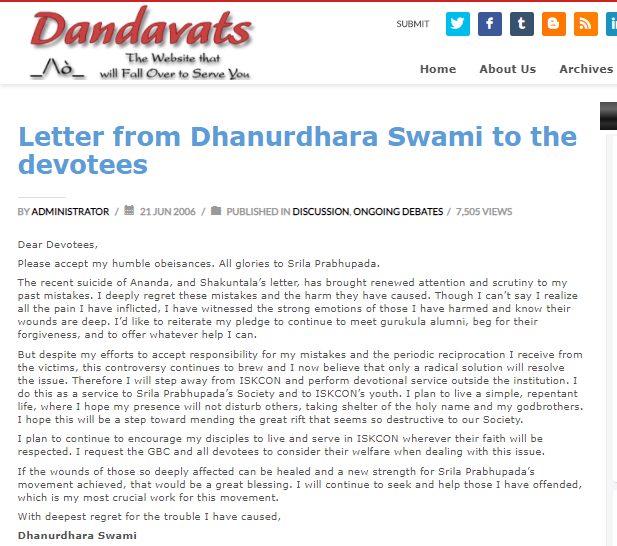
For those who may not be familiar, here is a link to Dhanurdhara’s 2006 ISKCON resignation letter.
I also included it as a photo at the bottom of this post.
I share this to remind devotees what Dhanurdhara claimed he intended to do.
We can compare his public statement with what he’s actually been doing since 2006.
Here are two key sentences from Dhanurdhara’s letter:
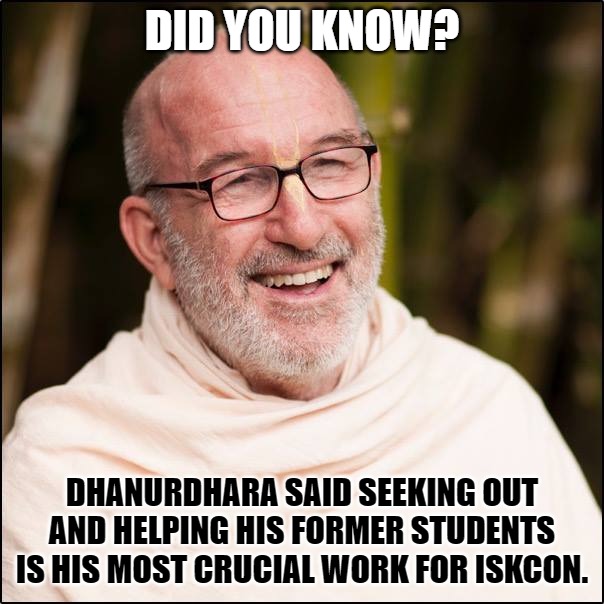
- “I plan to live a simple, repentant life, where I hope my presence will not disturb others, taking shelter of the holy name and my godbrothers.”
- “I will continue to seek and help those I have offended, which is my most crucial work for this movement.”
Sounds honorable. Right?
Is that what he did? In a word: NO.
What then, we may ask, has he been up to instead?
In 2020, this is how Dhanurdhara described his activities on his Facebook page:
“Dhanurdhara Swami spends half of the year in India where he focuses on bhajana, studying, writing and taking people on pilgrimage of holy places. The other half of the year Maharaja is in the West where he spends his time traveling and speaking about bhakti-yoga.”
From what we’ve observed, that description is pretty accurate. In India he leads groups on parikramas around Vrindavan and in the US he recruits new followers. Which, up until January 2019, was done mostly through the Bhakti Center in NYC and, until February 2020, through the MVT Trust Restaurant and Guesthouse in Vrindavan, India.
Under most circumstances, that would sound like a fantastic program. Right?
Except, when you consider it in context of three relevant things:
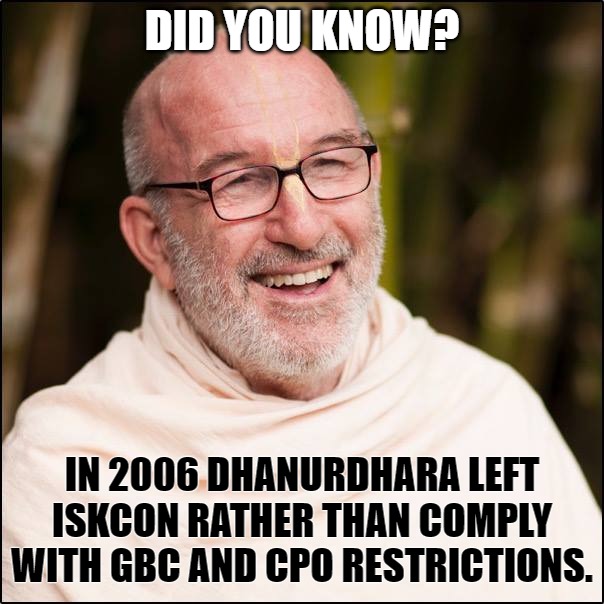
- Dhanurdhara voluntarily left ISKCON in 2006 so he wouldn’t be subject to the 2007 GBC Resolution barring anyone determined responsible for serious maltreatment of children from any leadership position in ISKCON, including initiating guru.
- When Dhanurdhara left ISKCON, he announced to the world he was going to “live a simple, repentant life,” where his presence “will not disturb others,” and to “continue to seek and help those I’ve offended,” which he claimed to be “my most crucial work for this movement.”
- In 2020, Dhanurdhara quietly petitioned the GBC to be allowed back in ISKCON, after neither abiding by the GBC resolutions (point 1), nor focusing on his most important work for Srila Prabhupada’s Society (point 2). Subsequently, both the GBC and CPO denied his request.
Bottom line: If, over the years since he formally left ISKCON in 2006, Dhanurdhara had actually carried out those self-declared noble intentions, we might very well have a different outcome from what’s been outlined above.
The good news is there is still hope Dhanurdhara will make the effort necessary to beg forgiveness for his egregious acts of vaishnava-aparadha – against hundreds of his former students. Which, for the record, are serious offenses he performed in the Holy Dhama of Vrindavan. Where, according to Srimad Bhagavatam, the effects of all activities are magnified 1,000 times.
I Beg Your Pardon – The Only Way to Atone for Vaishnava Aparadha
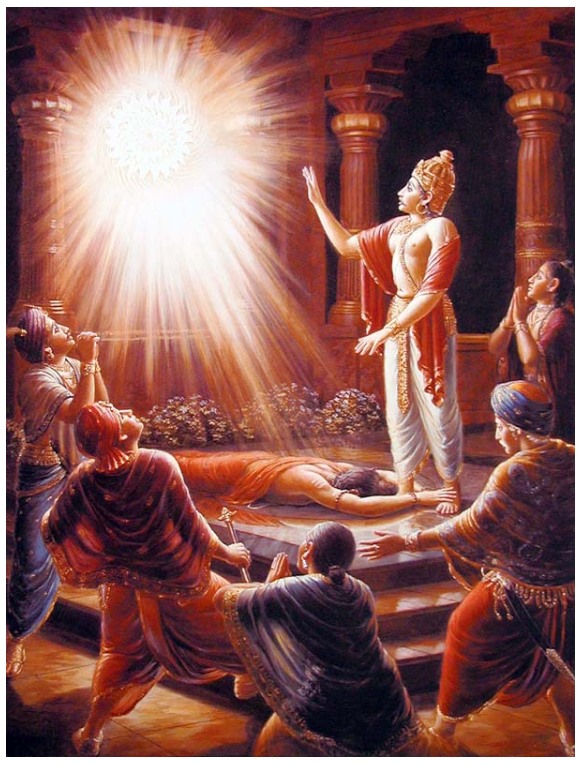
Too often, in ISKCON (and other related Gaudiya Vaishnava groups), Bhagavad Gita verse 9.30 is misquoted, or at least quoted out of context, and misapplied.
In Sanskrit, this is the “api cet su-duracaro” verse.
Here’s the English translation:
“Even if one commits the most abominable actions, if he is engaged in devotional service, he is to be considered saintly because he is properly situated.”
In his purport, Srila Prabhupada offers an important caution: “this verse only refers to an accident due to the strong power of material connections.”
There are clear instructions on the difference between what one can do in the event of an accidental fall down and what one must do in the case of Vaishnava-aparadha.
For instance, consider the stories of Hiranyakasipu and Prahlad Maharaj; Saubhari Muni and Garuda; Sacimata and Advaita Acarya; Jagai, Madhai, and Lord Nityananda; as well as Durvasa Muni and Ambarisa Maharaja.
In all of these situations, the Supreme Lord says amnesty is not His to give. That has to come from the offended devotee.
It’s important to keep in mind, while the offenders may still be considered Vaishnavas, they will not have properly atoned, or be able to fully revitalize their Krishna consciousness, until they have pleased – and are forgiven by – the offended Vaishnava.
Who says so? Our Scriptures say so.
For example, in the purport of Srimad Bhagavatam 4.26.24, Srila Prabhupada writes:
“The conclusion is that if Krsna consciousness is covered by material sins, one can eliminate the sins simply by chanting the Hare Krsna mantra, but if one pollutes his Krsna consciousness by offending a brahmana or Vaishnava, one cannot revive it until one properly atones for the sin by pleasing the offended Vaishnava or brahmana.”
The final sentence of this purport is crystal clear:
“A Vaishnava-aparadha cannot be atoned by any means other than by begging the pardon of the offended Vaishnava.”
Dhanurdhara’s Bhakti Center Restrictions
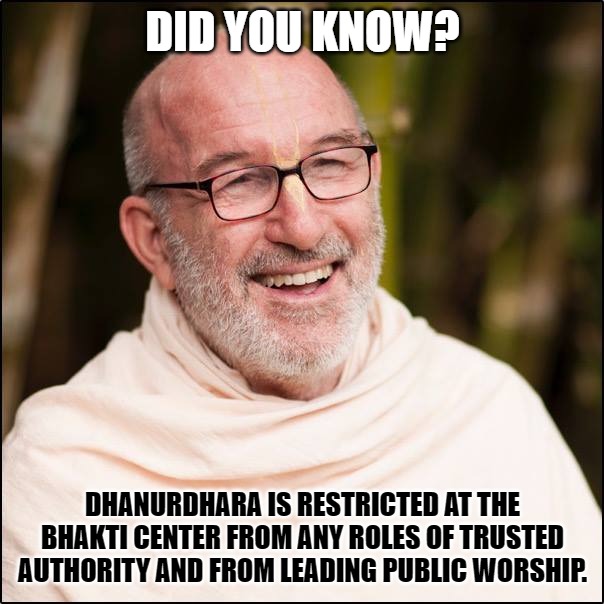
ISKCON Child Protection Guidelines state:
“No person, who has been determined to have engaged in severe maltreatment of children, will be allowed to remain active in a position of authority or trust within ISKCON, this includes activities such as leading kirtan, giving class, speaking publicly at any ISKCON event or representing ISKCON in official capacities.”
In February 2019 the Bhakti Center Directors confirmed the center will comply with ISKCON GBC resolutions and CPO policies and decisions regarding Dhanurdhara.
Dhanurdhara’s 2006 ISKCON Departure Letter
Below is Dhanurdhara’s official departure letter:
June 21st, 2006
Dear Devotees,
Please accept my humble obeisances. All glories to Srila Prabhupada.
The recent suicide of Ananda, and Shakuntala’s letter, has brought renewed attention and scrutiny to my past mistakes. I deeply regret these mistakes and the harm they have caused. Though I can’t say I realize all the pain I have inflicted, I have witnessed the strong emotions of those I have harmed and know their wounds are deep. I’d like to reiterate my pledge to continue to meet gurukula alumni, beg for their forgiveness, and to offer whatever help I can.
But despite my efforts to accept responsibility for my mistakes and the periodic reciprocation I receive from the victims, this controversy continues to brew and I now believe that only a radical solution will resolve the issue. Therefore I will step away from ISKCON and perform devotional service outside the institution. I do this as a service to Srila Prabhupada’s Society and to ISKCON’s youth. I plan to live a simple, repentant life, where I hope my presence will not disturb others, taking shelter of the holy name and my godbrothers. I hope this will be a step toward mending the great rift that seems so destructive to our Society.
I plan to continue to encourage my disciples to live and serve in ISKCON wherever their faith will be respected. I request the GBC and all devotees to consider their welfare when dealing with this issue.
If the wounds of those so deeply affected can be healed and a new strength for Srila Prabhupada’s movement achieved, that would be a great blessing. I will continue to seek and help those I have offended, which is my most crucial work for this movement.
With deepest regret for the trouble I have caused,
Here’s a link to his letter on Dandavats.
Dhanurdhara is Prohibited From MVT Guesthouse and Restaurant
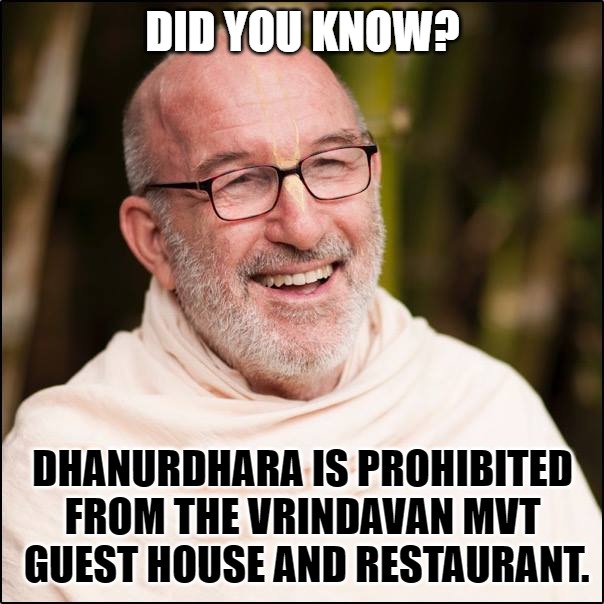
A statement about the MVT Trustees’ actions:
“Mayapur Vrindavan Trust (MVT) Trustees sought direction from the ISKCON Child Protection Office (CPO). Based on the response from the CPO, the MVT Trustees asked Dhanurdhara Swami to not enter the MVT premises (the Vrindavan Guesthouse and Restaurant). On February 26, 2020, Dhanurdhara Swami agreed to comply.”
Here’s a link to a change.org petition update about the above statement.
2018 ISKCON GBC Child Protection Policy Clarifies Restrictions for Dhanurdhara
The 2018 GBC Child Protection Policy confirms Dhanurdhara has lifetime restrictions in ISKCON from holding any roles of trusted authority and in leading public worship:
“No person, who has been determined to have engaged in severe maltreatment of children, will be allowed to remain active in a position of authority or trust* within ISKCON, this includes activities such as leading kirtan, giving class, speaking publicly at any ISKCON event or representing ISKCON in official capacities.”
“*Position of trust or authority include any of the following: 1. Having any position of leadership within ISKCON. 2. Giving class or leading kirtan in the temple or at any ISKCON related program/festival. 3. Having any service that involves contact with children.”
Here’s a link to the 2018 GBC Child Protection Resolutions.
2007 GBC Restrictions for Dhanurdhara
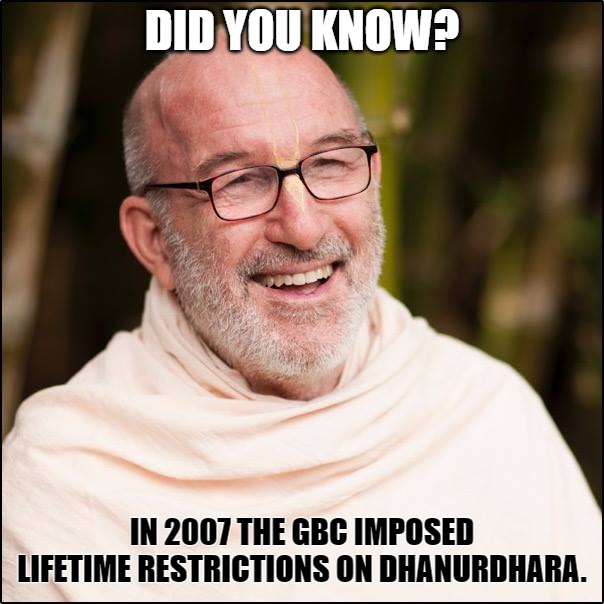
2007 GBC Resolution 312 Part B. Positions of Leadership
“[Statement] RESOLVED:
Whenever the ISKCON Central Office of Child Protection rules that an offense is such as to restrict a person from serving in ISKCON in positions of leadership (including but not limited to offices of GBC, minister, zonal secretary or temple officer), the restriction must include the position of initiating guru. This restriction shall apply to all previous and future decisions of the Central Office of Child Protection.”
Here’s a link to the full 2007 GBC Resolutions.
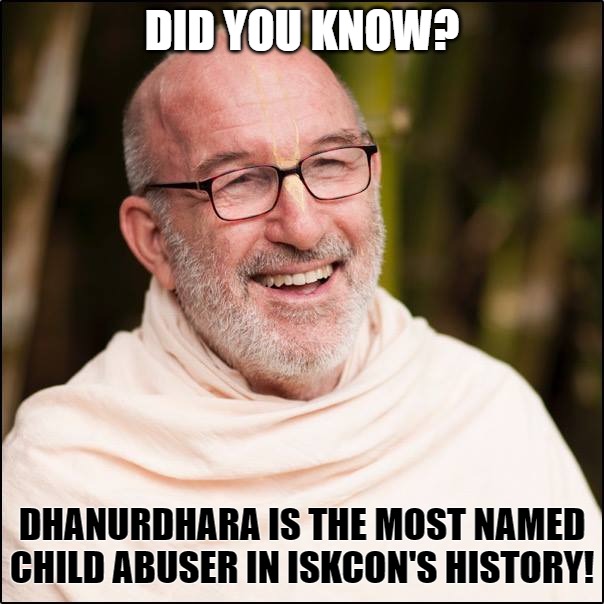
Dhanurdhara – Most Named Child Abuser in ISKCON’s History
Here is an excerpt from a 2006 report by ISKCON’s legal counsel to the Child Protection Office and GBC:
“As a result of the litigation in Texas, and the 600-plus claims filed in the bankruptcy court, we now have a vast body of information (evidence) that was not available in 1999. Although much was known with respect to allegations of physical and mental child abuse by Dhanurdhara Swami at the Vrindavan gurukula, we now have even more information than we had at that time. Based upon this additional information, it is now unequivocally clear to ISKCON’s legal team that the damage inflicted by Dhanurdhara Swami was significantly greater than that which was known in 1999. In fact, Dhanurdhara Swami is named as an abuser in the bankruptcy claims far more than any other person.”
For emphasis, I’ll repeat the last sentence to make sure we catch the significance:
“In fact, Dhanurdhara Swami is named as an abuser in the bankruptcy claims far more than any other person.”
The report concluded:
“We have seen and reviewed firsthand the claims filed in the bankruptcy court documenting the severe abuse inflicted on the Vrindavana gurukula children by Dhanurdhara Swami, as well as the CPO information. From a legal standpoint, we have no doubt that these claims are legitimate.”
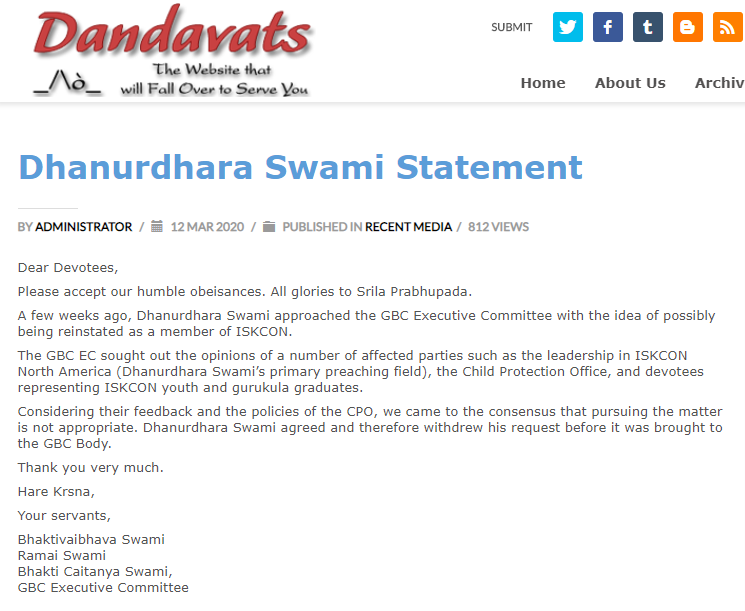
ISKCON GBC Executive Committee’s Statement About Dhanurdhara
By: The GBC Executive Committee for ISKCON News on March 15, 2020
A few weeks ago, Dhanurdhara Swami approached the GBC Executive Committee with the idea of possibly being reinstated as a member of ISKCON. The GBC EC has discussed the topic and issued a statement:
“Dear Devotees,
Please accept our humble obeisances. All glories to Srila Prabhupada.
A few weeks ago, Dhanurdhara Swami approached the GBC Executive Committee with the idea of possibly being reinstated as a member of ISKCON.
The GBC EC sought out the opinions of a number of affected parties such as the leadership in ISKCON North America (Dhanurdhara Swami’s primary preaching field), the Child Protection Office, and devotees representing ISKCON youth and gurukula graduates.
Considering their feedback and the policies of the CPO, we came to the consensus that pursuing the matter is not appropriate. Dhanurdhara Swami agreed and therefore withdrew his request before it was brought to the GBC Body.
Thank you very much.
Hare Krsna,
Your servants,
Bhaktivaibhava Swami
Ramai Swami
Bhakti Caitanya Swami,
GBC Executive Committee”
Here is a link to this announcement posted on the ISKCON News website.
Here’s a link to this announcement posted on Dandavats.
ISKCON North American GBC Council Statement Regarding Dhanurdhara Swami
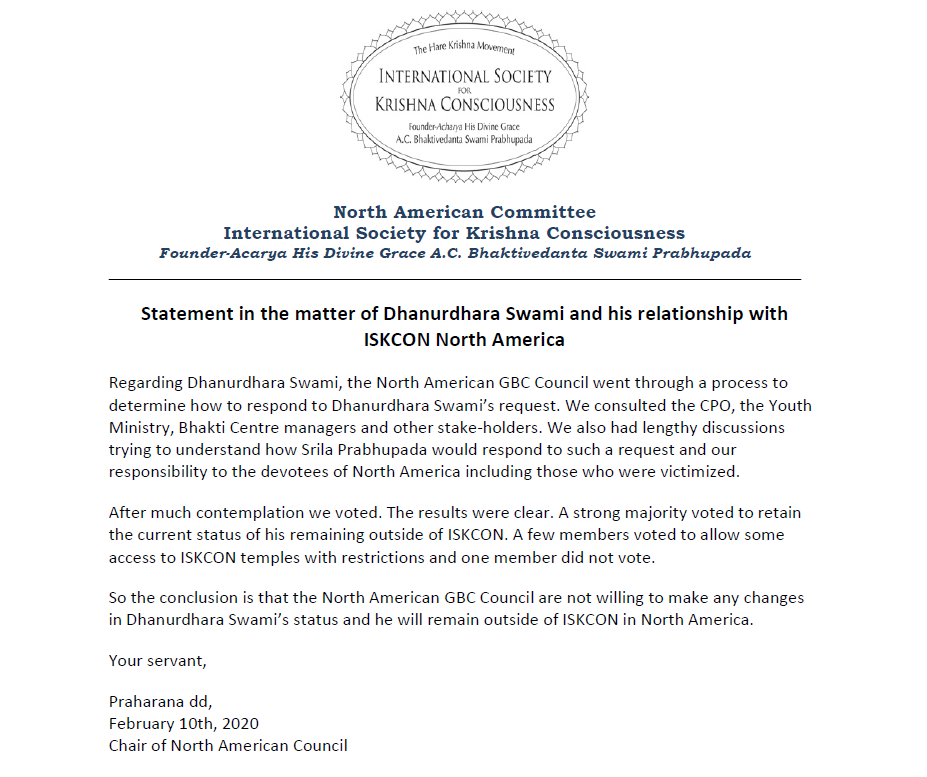
February 10th, 2020
Regarding Dhanurdhara Swami, the North American GBC Council went through a process to determine how to respond to Dhanurdhara Swami’s request. We consulted the CPO, the Youth Ministry, Bhakti Centre managers and other stake-holders. We also had lengthy discussions trying to understand how Srila Prabhupada would respond to such a request and our responsibility to the devotees of North America including those who were victimized.
After much contemplation we voted. The results were clear. A strong majority voted to retain the current status of his remaining outside of ISKCON. A few members voted to allow some access to ISKCON temples with restrictions and one member did not vote.
So the conclusion is that the North American GBC Council are not willing to make any changes in Dhanurdhara Swami’s status and he will remain outside of ISKCON in North America.
Your servant, Praharana dd, Chair of North American Council

Recent Comments
God, acbsp on Who Set The Standards? God, acbsp on Who Set The Standards? Gpd on Who Set The Standards? Dhanurdhara’s… on ISKCON North America Child Pro… Dhanurdhara’s… on ISKCON North American GBC Coun…


 Seeking The Essence